
Quo vadis, private equity?
Do you feel like the term “private markets”, whether equity, credit, or infrastructure, has been appearing in almost every investment prospectus lately? You are not imagining it.
It is 2025, and the Czech market is being flooded with an ever-growing number of feeder funds and platforms promising what once seemed unthinkable: opening the doors to previously exclusive asset classes to a much broader group of investors.
Yet history teaches us that when Wall Street begins mass-marketing the “next gold mine,” the same warning signs tend to appear: limited transparency, complex structures, and calculations that even industry professionals can struggle to fully understand.
Private equity is a fascinating asset class, especially for fund managers (GPs), who have collected more than a trillion dollars in fees over the past quarter-century. For investors and wealthy families, however, the reality is considerably more challenging.
In our new article series, “Quo vadis, private equity?”, we open a debate that many distributors would rather avoid. Our aim is to educate and shed light on areas where what were once genuine family office services, built around individual strategy, have quietly evolved into the distribution of standardized, off-the-shelf products wrapped in feeder structures.
Navigating this world has become increasingly difficult for investors. Without professional and independent due diligence, you may effectively be buying a “black box.”
We ask a simple question: Do investors really know what they are buying?
And once all the fees are taken into account, potentially amounting to 3–7% p.a. in total costs, how much room is actually left for the promised outperformance? Especially now that the forty-year era of declining interest rates and cheap leverage has come to an end and the market is searching for a new equilibrium.
If you do not want to simply pay a premium for “beta,” private equity requires you to commit perhaps your most valuable resource: time. It requires in-depth analysis and the ability to maintain a critical distance.
This series is intended for those who want to look beyond the marketing slogans and understand why due diligence matters more today than ever before. In this segment, perhaps more than anywhere else, investment decisions should be based on the ability to look through complex structures and the illusion of liquidity, rather than on faith in a glossy prospectus.
What you will find in this series
- Origins and the first major wave
- The second wave and the path to the mainstream
- The golden decade of private equity (2004–2007)
- Recovery, expansion, and the tipping point (2010–2023)
- Private equity in 2025
- Some final thoughts on the private equity series
- Sources and references
1. Origins and the first big wave
“I don’t think the strategies that we have employed over the past 40 years are going to work going forward.” - Marc Rowan, CEO, Apollo
“One thing, though, is certain: success over the next four decades will look different than success over the last four.” - Matt Mendelsohn, CIO, Yale
The early days of private equity
Private equity (PE) in its modern form began to take shape in the 1970s with the emergence of the first leveraged buyouts (LBOs). Among the pioneers were Jerome Kohlberg Jr. and his colleagues Henry Kravis and George Roberts, who left investment bank Bear Stearns in 1976 to found Kohlberg Kravis Roberts (KKR), one of the first firms to specialize in LBOs.
Their acquisition strategy focused on companies whose owners had few obvious exit options. The businesses were often too small for the public markets, while their founders had little interest in selling to competitors. KKR and similar investors offered an alternative: acquire the company using a large proportion of debt and a relatively small amount of equity. In other words, use financial leverage.
A typical LBO in the 1980s was financed with approximately 70% debt and just 30% equity. This structure dramatically increased the potential return on the equity invested, but it also magnified the risk.
One of the best-known early examples was the 1982 acquisition of greeting card manufacturer Gibson Greetings. A group of investors contributed just $1 million of their own capital and borrowed another $79 million to acquire the company for $80 million. Only 18 months later, Gibson Greetings went public at a valuation of $290 million. The enormous profit immediately caught the attention of the era’s “corporate raiders.”
This success triggered the first major wave of interest in LBOs. Between 1979 and 1989, more than 2,000 LBO transactions were completed, representing a dramatic increase compared with previous decades.
The rise of LBOs was also fueled by the development of the high-yield, or “junk,” bond market. Traditional bank financing was often unavailable for large and highly leveraged acquisitions, but high-yield bonds offered another way to raise billions of dollars from investors willing to accept greater risk in exchange for higher interest rates.
At the center of this market was Michael Milken of investment bank Drexel Burnham Lambert, who became known as the “King of Junk Bonds.” Milken built an extensive network of high-yield investors and issued “highly confident letters” to prospective acquirers, indicating that he was highly confident the necessary debt financing for an acquisition could be raised. In this way, Milken helped finance numerous LBOs and worked with firms such as KKR on their acquisitions.
The ready availability of debt, albeit at high interest rates, also gave rise to a new generation of “corporate raiders” willing to pursue hostile takeovers. Prominent figures included Carl Icahn, T. Boone Pickens, Victor Posner, and Saul Steinberg, investors who aggressively accumulated shares and launched takeover bids for established companies.
The media often portrayed them as raiders who dismantled businesses, laid off employees, and profited from selling their assets.
By the late 1980s, however, euphoria collided with reality. The excesses of the first LBO wave resulted in increasingly expensive deals and mounting risk. Loose lending standards and massive issuance of high-yield bonds were clear signs that the market was overheating.
Eventually, the high-yield bond market collapsed. Investors lost their appetite for financing increasingly risky transactions, and some of the largest LBOs began to run into serious trouble.
The symbolic peak of this era, and a warning of what was to come, was the decade’s biggest deal: the takeover of RJR Nabisco in late 1988.
The Iconic Story of RJR Nabisco
RJR Nabisco had been created through the merger of food company Nabisco and tobacco company R.J. Reynolds. In 1988, its CEO, F. Ross Johnson, considered taking the company private together with management.
The proposed leveraged buyout quickly grew far beyond the original plan. Once news of the deal became public, it triggered an unprecedented bidding war. KKR, led by Henry Kravis, entered the contest alongside investment bank Shearson Lehman Hutton, which backed the management bid, and several other players.
What followed became the subject of Barbarians at the Gate, the definitive account of the transaction by Bryan Burrough and John Helyar. Rival groups bid billions of dollars against one another for control of the corporate giant.
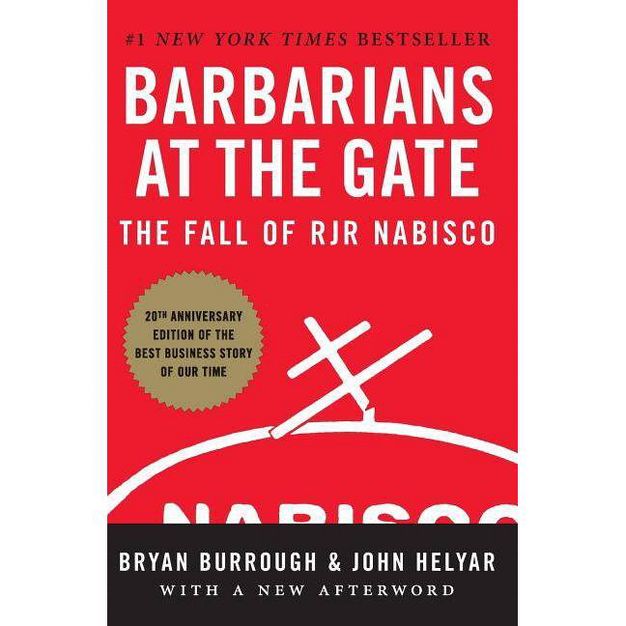
The result was the largest LBO in history at the time.
KKR ultimately offered approximately $109 per share, valuing RJR Nabisco at around $25 billion. The board chose KKR’s offer even though the competing group led by Johnson reportedly offered $112 per share, in part because KKR’s financing was considered more reliable and its proposal involved less dismantling of the company.
The transaction closed in early 1989 and set an extraordinary record. It remained the world’s largest LBO for the next 17 years, until 2006.
But the deal also exposed the darker side of leveraged buyouts.
KKR financed the acquisition with enormous amounts of debt, leaving RJR Nabisco with a debt burden of approximately $25 billion that had to be serviced from the company’s cash flow.
A difficult period followed. The new owners sold parts of the business, reduced headcount, and struggled with interest payments. Johnson left the company with a $23 million golden parachute. During the 1990s, parts of RJR Nabisco were gradually sold to other companies, with its food businesses eventually becoming part of what is now Kraft Heinz and Mondelēz International.
The euphoria became a warning: RJR Nabisco demonstrated that LBOs could generate enormous profits for successful investors, but could also leave companies burdened by debt and highly vulnerable.
The RJR Nabisco transaction reverberated across Wall Street and among regulators. It sparked a broader debate about the ethics of financial engineering and whether a small group of investors should be able to become extraordinarily wealthy by extracting value from companies at the expense of their long-term health.
By the end of the 1980s, RJR Nabisco had come to represent both the peak and the end of the first LBO era. Following this megadeal, the leveraged buyout market cooled dramatically. By the mid-1990s, transactions of similar ambition had almost disappeared.
The environment had changed. High interest rates and the collapse of the junk bond market made both investors and banks more cautious, and for a time, “LBO” became almost a dirty word.
Private equity would eventually experience another boom under far more favorable conditions. But we are getting ahead of ourselves.
Academia in Practice: Yale and David Swensen
While the 1980s produced dramatic stories such as RJR Nabisco, a very different investment revolution was quietly taking place in the background.
It was not unfolding on the front pages of newspapers, but inside university endowments.
David F. Swensen, who joined Yale University as Chief Investment Officer in 1985, became one of the pioneers of a new investment paradigm. Drawing on both academic thinking and his own investment judgment, Swensen believed that large institutional investors, including university endowments and pension funds, could achieve superior long-term results by allocating capital to alternative and less liquid assets, including private equity.
In his book Pioneering Portfolio Management, Swensen compared investing in a private equity fund to a long-term commitment, almost like marriage:
“While it falls far short of the gravity of the decision to get married, funding a private equity firm is a truly long-term commitment.”
As we have written previously, Family Office Partners is publishing the first Czech translation of this very book in 2026. One of the reasons is simple: many of the fundamental principles behind Swensen’s approach remain highly relevant to the way we think about managing long-term family wealth in our multi-family office.
The Yale Model was built partly around the idea that patient capital could capture an illiquidity premium. While Wall Street focused largely on assets that could be traded easily, Swensen believed that attractive opportunities could be found in less liquid and less efficiently priced parts of the market.
As he put it:
“Because market players routinely overpay for liquidity, serious investors profit by avoiding overpriced liquid securities and instead accepting less liquid alternatives.”
Under Swensen’s leadership, Yale gradually increased its allocation to alternative investments. From almost no exposure in the late 1980s, the endowment eventually reached a point where more than half of its portfolio was invested in illiquid assets, including venture capital, real estate, natural resources, and leveraged buyout funds.
Yale’s target allocation to leveraged buyouts alone reached approximately 17.5% of the portfolio, while venture capital accounted for around 23%.
The strategy proved remarkably successful. Yale’s endowment became one of the best-performing institutional portfolios in the world.
Over Swensen’s 36 years at Yale, from 1985 to 2021, the endowment generated an average annual return of 13.7%. This meant Yale earned approximately $50 billion more than it would have generated by merely matching the average performance of comparable institutions. Unsurprisingly, Swensen’s success inspired an entirely new generation of investors.
During the 1990s, and particularly after 2000, the Yale Model spread across universities, foundations, and pension funds. Large university endowments increasingly allocated substantial portions of their portfolios to alternative investments such as private equity and venture capital.
The idea took hold that investors with genuinely long time horizons could accept illiquidity in exchange for the potential of higher returns.
Swensen effectively bridged academic theory and investment practice. He demonstrated that while LBO funds and other alternative investments are not for everyone, they can be a source of outperformance for sophisticated investors when approached correctly.
His legacy continues to influence institutional portfolio management around the world.
Swensen’s successor at Yale, Matt Mendelsohn, noted in 2023 that patience with illiquid assets would remain an important competitive advantage for Yale. At the same time, he cautioned that illiquidity itself does not generate excess returns. These markets are no longer as overlooked as they once were, precisely because so many large institutional investors have entered them.
We will return to this in later installments.
The first lesson from private equity:
The history of the first LBO transactions and the birth of private equity offers a wealth of material for learning. What can we take away from the 80s for today's investment practice?
The history of the first LBOs and the emergence of modern private equity offers plenty to learn from. So what can the 1980s teach today’s investors?
1) Excess returns are harder to achieve
In the early 1980s, private equity could generate extraordinary returns, although the industry was also highly controversial. Today, private equity is a mature and established asset class, and the return picture has changed considerably.
Greater competition and enormous inflows of capital have compressed the potential for outperformance relative to public markets.
Oxford professor Ludovic Phalippou has argued that, in recent years, average private equity returns to investors have moved closer to those of public equity indices, while coming at significantly higher costs.
In other words, fees can absorb a substantial share of gross investment returns. Phalippou estimates that a typical private equity fee structure can consume around 4–7 percentage points of gross annual returns.
An investor considering private equity today should therefore ask whether the potential excess return after all fees is genuinely attractive.
There is another lesson from the 1980s: debt is a good servant but a bad master.
The first major wave of LBOs was built around the idea that leverage could multiply equity returns. It can, but only up to a point. Excessive leverage can also cripple a company.
Many of the “corporate raider” transactions of the 1980s ultimately failed to improve the underlying performance of the businesses they acquired.
An analysis by investor Dan Rasmussen found that revenue growth slowed after the acquisition in more than 50% of LBO transactions, while operating margins declined in 45% of cases. Rather than producing miraculous operational improvements, excessive debt often forced companies to cut costs and sell assets, potentially weakening their long-term growth prospects.
Today’s private equity funds have learned some of these lessons. Transactions are generally financed more conservatively, typically with around 50% equity compared with roughly 30% in the 1980s. Interest coverage receives greater scrutiny, and following the Global Financial Crisis, US regulators introduced guidance discouraging leveraged transactions with debt levels above approximately 6× EBITDA.
Still, the basic principle remains unchanged. A reasonable amount of debt can be useful. It can impose discipline and enhance equity returns.
The key word is reasonable.
2) Transparency and industry credibility
In the 1980s, the LBO world was relatively opaque and surrounded by an aura of mysterious financial engineering.
Four decades later, private equity has become mainstream. Teachers’ pension funds, university endowments, and HNW and UHNW investors all allocate capital to the asset class.
That development has also brought increasing pressure for greater transparency toward both investors and the public.
The disclosure of fund economics, for example, revealed the extraordinary wealth accumulated by partners at private equity firms. According to research by Ludovic Phalippou, private equity executives received approximately $230 billion in carried interest between 2006 and 2015, contributing to the creation of around twenty new billionaires.
These figures fueled criticism of the industry and increased pressure from LPs to reduce fees and improve transparency around fund performance.
Today, fund managers routinely report detailed metrics such as IRR, Public Market Equivalent (PME), and valuation sensitivity. Regulators, including the US SEC, have also sought to improve transparency around costs and the information provided to investors, although those efforts have not always been successful.
Private equity has evolved from an exotic and sometimes distrusted corner of finance into a respected part of global capital markets. That is, in itself, a positive development.
At the same time, private equity no longer operates in the shadows. Major acquisitions and their effects on employment, corporate debt, and the broader economy receive significant public and media scrutiny. Fund managers therefore have to consider their reputation as well as their investment returns.
The first era of private equity ultimately taught investors about the power and danger of leverage, the importance of properly aligned management incentives, and the value of taking a long-term approach.
Much has changed since the 1980s. The industry has matured, regulation has increased, and average returns have moved closer to those available elsewhere in the market.
But the fundamental principles remain remarkably similar.
Private equity is still about finding alpha in inefficient parts of the market, using capital intelligently, both equity and debt, and having patience.
2. The second wave and the path to the mainstream (1990s to early 2000s)
The second part of our five-part series on the evolution of private equity picks up after the dramatic end of the 1980s. Following the record $25 billion buyout of RJR Nabisco in 1989, which was four times larger than any previous LBO, the industry faced a harsh reality check. In the 1990s, however, private equity gradually recovered and evolved from a niche specialty into a respected part of the financial mainstream.
So how did this second wave unfold from the early 1990s to the early 2000s, and what lessons does it hold for investors today?
Market freeze after RJR Nabisco and the ecovery of private equity
The great LBO era of the 1980s culminated in the 1988–1989 battle for RJR Nabisco, immortalized in the bestseller Barbarians at the Gate. The aftermath was painful. Record debt levels and the collapse of the junk bond market sent the entire LBO industry into a deep slump.
Headlines of the time spoke for themselves: “Bitter Lessons of the Debt Decade” and “Leveraged Buyouts Fall to Earth.”
The numbers confirm the scale of the downturn. New investor commitments to private equity, excluding venture capital, fell from $11.9 billion in 1989 to just $4.8 billion in 1990 and $5.6 billion in 1991. Large public-to-private transactions nearly disappeared, with fewer than ten completed in the US in both 1991 and 1992.
Several factors were at work: tighter credit following the collapse of Drexel Burnham Lambert, the onset of recession, and stricter regulation.
In short, the private equity industry had to learn how to walk again.
The turnaround came with the economic recovery of the mid-1990s. The US M&A market regained momentum, with announced transaction volume reaching $649 billion in 1996, compared with roughly $100 billion in 1992.
Large mergers at the time were still dominated by strategic buyers seeking synergies, consolidation, or access to new technologies. Traditional public-to-private LBOs remained relatively subdued.
Private equity funds adapted by moving into smaller, less obvious opportunities.
They began acquiring non-core divisions of large corporations, the “unwanted children” of conglomerates, improving them operationally and later selling them or taking them public.
Another increasingly popular approach was the leveraged build-up, or roll-up strategy. A fund would support a management team in acquiring multiple companies in a fragmented industry and combining them into a larger, more efficient business.
Roll-up strategy is an investment approach in which an investor or private equity fund acquires several smaller companies in the same or related sectors and combines them into a larger platform.
These incremental strategies helped private equity regain its footing, even though the return of true megadeals was still some years away.
The rise of institutional capital: pension funds, endowments, and the first sovereign wealth funds
One of the most important drivers of private equity’s second wave was the arrival of institutional capital.
Where private equity had once relied largely on wealthy families and banks, the 1990s brought increasing commitments from pension funds, university endowments, and sovereign wealth funds.
Regulatory changes in the US in the late 1970s, particularly the relaxation of the “prudent man” rule for pension investments, had already opened the door for large institutions to allocate capital to alternative assets.
The impact was dramatic. Private equity assets under management grew from less than $5 billion in 1980 to more than $175 billion by 1995.
By the 1990s, private equity had become a meaningful component of institutional portfolios, with typical allocations of around 5% for public pension plans and as much as 10–15% for endowments and foundations.
In the US, CalPERS, the California public pension giant, was among the early institutional investors to enter private equity, beginning in 1990.
An interesting reference point when reading prospectuses from local PE distributors: since launching its private equity program, CalPERS has achieved a total net IRR of approximately 11.1% and a net multiple of around 1.5x. Yale has done considerably better. Do the math. We are talking about an institution with access to some of the best funds in the world. Its sheer size, however, is also a disadvantage, because it is often too large to access smaller and mid-market opportunities. Paradoxically, that can be an advantage for investors such as Family Office Partners.
Other major pension funds representing teachers, firefighters, and public-sector employees followed. For these institutions, private equity’s attractive double-digit returns offered a welcome complement to traditional equities and bonds.
University endowments such as Yale and Harvard, inspired by investors such as David Swensen, embraced what became known as the Yale Model, increasing allocations to alternatives, including venture capital and buyout funds.
The results were strong. During the 1990s, university endowments achieved average annual private equity returns of roughly 13%, among the highest of any institutional investor group.
Sovereign wealth funds also began to play a growing role. Countries with large fiscal or resource surpluses created investment vehicles to preserve and grow national wealth. By 1990, sovereign wealth funds collectively managed an estimated $500 billion, and institutions such as Singapore’s GIC and Kuwait’s KIA had already begun investing part of their capital in international private equity funds.
The institutionalization of private equity brought hundreds of billions of dollars of relatively stable capital into the industry and made it possible to raise funds far larger than anything managed by the “wild” dealmakers of the 1980s.
Institutional capital also accelerated the professionalization of private equity.
Fund managers now had to meet demanding expectations around transparency, reporting, governance, and risk management. Legal structures gradually became standardized around limited partnerships and the GP/LP model, while compensation conventions converged toward the familiar structure of roughly a 2% management fee plus 20% carried interest.
Track records and reputation also became increasingly important. Pension funds and endowments could afford to be selective, and the arrival of these institutional “whales” raised the bar for the entire industry.
Private equity was no longer an informal club of a few aggressive dealmakers. It was becoming a respected part of the global investment ecosystem.
Megadeals and globalization: from domestic transactions to a global business
By the late 1990s, private equity was once again moving toward much larger transactions and expanding beyond its original US base.
Favorable capital-market conditions, readily available credit, and a growing economy made increasingly ambitious deals possible.
By 1997, the financial press was already commenting on the flood of new buyout funds exceeding $1 billion in size. At the time, some LPs worried that there might not be enough attractive large acquisitions to absorb all that capital.
Skeptics warned that managers might drift away from proven strategies simply because they had too much money to invest.
As it turned out, many of these large funds performed reasonably well and paved the way for even larger vehicles. By 2007, Blackstone had raised a record $21.7 billion for Blackstone Capital Partners V.
Leveraged buyouts had become so deeply embedded in financial markets that by 2007, private equity transactions accounted for roughly 28% of total US M&A volume, compared with just 4% in 1997.
Private equity had become mainstream. Multi-billion-dollar funds and transactions had become a permanent feature of global capital markets.
The globalization of the industry was equally important.
Until the 1990s, private equity had been dominated by the US, with a smaller concentration of firms in London. During the second half of the decade, however, the industry became increasingly international.
In Europe, regulatory changes allowed pension funds and insurance companies to allocate more capital to private equity and venture capital. This helped create a mature European PE market and supported the rise of firms such as Permira, CVC, and EQT.
US giants followed. Firms such as KKR and Blackstone opened offices in London and began pursuing major European transactions.
Asia also came into focus. Carlyle Group was among the pioneers, establishing a regional headquarters in Hong Kong in 1998 and launching its first Asian buyout fund, worth $750 million, the following year.
Investments in Japan, South Korea, China, and India followed.
By the end of the 1990s, leading private equity firms were active across three continents and large cross-border transactions had become a reality.
In 1999, for example, KKR acquired Canadian pharmacy chain Shoppers Drug Mart and later successfully took it public, demonstrating that profitable exits could be achieved outside the investor’s home market.
Private equity firms learned to operate globally by combining local teams and relationships with international networks, capital, and expertise.
What had begun as a largely domestic LBO market had evolved into a genuinely global asset class, with capital from one country financing companies on the other side of the world.
Technology and the dot-com bubble: private equity meets venture capital
The turn of the millennium brought the euphoria of the dot-com boom, and the paths of traditional buyout funds and venture capital began to diverge.
By the late 1990s, enormous amounts of capital were pouring into technology start-ups and internet companies. The sheer volume of money flowing into the sector was impossible to ignore.
In 2000, venture capital funds raised almost as much capital as major buyout funds, an unusual situation historically.
That same year, venture investors deployed more than $100 billion globally into new companies, while valuations climbed rapidly.
More conservative buyout investors often stayed on the sidelines. Their strategies, typically focused on established businesses with predictable cash flow, were not an obvious fit for the speculative world of dot-com investing.
Still, some private equity firms could not resist the temptation. They launched specialist technology funds or acquired minority stakes in rapidly growing telecom and technology companies.
Tim Sullivan, who has spent 39 years with Yale’s private equity team, recently recalled the period in one interview:
“During the .com boom, everything worked. One of our VCs said, ‘We sell our winners for 20 times our money, and our losers for three times our money.’”
The sobering reality arrived after 2000, when the technology bubble burst.
For private equity, the episode offered two lessons in real time.
First, even experienced buyout investors were not immune to sectors overheated by excessive capital.
Several well-known private equity firms suffered severe losses in technology and telecom investments. Texas-based Hicks, Muse, Tate & Furst, for example, reportedly wrote off around $1 billion across six telecom companies and thirteen internet investments made near the top of the bubble.
Legendary investor Ted Forstmann made major bets on McLeod USA and XO Communications. Both ended in bankruptcy, effectively destroying his firm, Forstmann Little, which never raised another fund and later faced litigation from investors.
The failure of such high-profile players shook LP confidence and led to greater emphasis on due diligence and tighter restrictions on manager discretion in fund agreements.
The second lesson was that disciplined diversification and patience could be more valuable than chasing fashionable themes.
Investors who resisted the urge to buy into overheated technology companies at any price avoided the worst of the losses.
Conversely, funds that invested selectively in 2001 and 2002, after valuations had fallen sharply, often generated strong subsequent returns.
Lower purchase prices and more conservative leverage created a strong foundation for returns once the economy recovered.
This was also true for a number of European buyout funds, which became more active in the early 2000s. In 2001, European LBO volume, at approximately $44 billion, exceeded US volume of roughly $10.7 billion for the first time, as the American market remained weakened by the aftermath of the dot-com crash.
Venture capital as a whole suffered a deep downturn after 2000. Investment activity contracted sharply and fund returns fell into negative territory.
Traditional private equity recovered more quickly.
Although buyout funds completed fewer transactions and used less leverage in the years immediately following the crash, they retained the support of institutional LPs, many of whom reduced venture allocations instead.
As a result, private equity entered the new millennium with a reputation for being a more disciplined and sober investor compared with the wild ride of dot-com venture capital.
That reputation would prove useful, because another cycle of rapid growth, followed by another test of resilience, was approaching.
Lessons for today: sector diversification and the cycle of cheap debt
The turbulent 1990s and early 2000s left the investment community with several lessons that remain highly relevant to private equity today.
1) Do not chase a single sector or fashionable theme
The flood of capital into the technology bubble demonstrated how dangerous excessive concentration can be.
Diversification across sectors and investment strategies remains one of the key foundations of portfolio resilience.
Even established private equity firms such as Hicks Muse and Forstmann Little suffered badly from concentrated exposure to technology, media, and telecom.
Their failures remain a useful reminder for today’s investors chasing the “next great technology story.”
Successful managers learned to think more carefully about how much capital they allocate to overheated sectors rather than betting everything on a single theme.
2) Respect the cycle of cheap debt
Cheap and abundant credit is often the fuel behind private equity booms.
That was true in the 1980s, during the late-1990s expansion, and later during the “golden era” of 2005–2007.
But conditions can reverse quickly.
After RJR Nabisco, credit markets tightened sharply and LBO activity collapsed.
A similar dynamic played out after 2000. Defaults on high-yield bonds rose to their highest levels since 1990, peaking at around 10.7% in early 2002, while leveraged financing temporarily dried up.
Private equity funds that had grown accustomed to cheap debt suddenly had to contribute more equity and accept smaller transaction sizes.
Paradoxically, those tougher conditions also laid the groundwork for attractive returns, because acquisition valuations were lower.
The lesson is simple: debt cycles are unforgiving.
Investors therefore watch macroeconomic conditions and credit spreads closely. When money is cheap and plentiful, caution and reserve-building become increasingly important. When banks are restrictive and borrowing is expensive, some of the best opportunities may emerge for patient investors.
These lessons remain relevant today.
Private equity is entering the second half of the 2020s as a far more diversified industry. Large managers now invest across technology, healthcare, infrastructure, credit, real estate, and growth strategies alongside traditional buyouts.
Managers also speak much more openly about preparing for periods when cheap money disappears and valuations decline.
As Howard Marks of Oaktree has often observed, investment cycles and human nature do not fundamentally change. Euphoria eventually gives way to fear, and those who maintain perspective and discipline tend to be in a stronger position.
Despite everything that has changed over the past few decades, the answer to quo vadis, private equity? still depends largely on whether we can learn from past excesses and remain faithful to the basic principles of disciplined investing.
3. The golden decade of private equity (2004–2007)
In the second part of our series, we saw how private equity recovered from the market collapse of the early 1990s and, fueled by an influx of institutional capital, moved firmly into the financial mainstream. The period brought the first megadeals, global expansion, and some painful lessons from the dot-com bubble. Now let us see whether the industry actually learned from them.
Levné peníze, vysoké valuace, rekordní objemy – srovnání s předchozími cykly
Cheap money, high valuations, record volumes: echoes of previous cycles
The period from 2004 to 2007 went down in private equity history as a “golden era.” Following the bursting of the dot-com bubble and the subsequent decline in interest rates to historically low levels, the world entered an era of cheap money. Combined with strong demand from institutional investors, this triggered an explosion in leveraged buyout (LBO) activity.
The numbers speak for themselves. While private equity accounted for just 4% of global M&A volume in 2000, by the first half of 2007 its share had risen to around 20%. Funds were accumulating capital at a staggering pace, with assets managed by buyout funds growing by 33% annually between 2004 and 2007 to approximately $900 billion worldwide.
The result was an unprecedented buying spree. The total value of large LBOs above $1 billion surged from $28 billion in 2000 to $502 billion in 2006. In the first half of 2007 alone, announced buyouts reached another approximately $501 billion.
This was several times the volume seen at the previous peak in the late 1990s and, in nominal terms, exceeded even the records of the 1980s, including the legendary RJR Nabisco transaction.
The return of abundant capital and banks’ willingness to finance acquisitions on a massive scale also drove up valuations and leverage.
By the end of the period, LBO purchase multiples had climbed to approximately 8–9× EV/EBITDA in the US and 9–10× in Europe. Debt levels on large buyouts commonly reached 7–8× EBITDA, far above the more conservative structures seen earlier in the decade.
Innovations such as covenant-lite, or “cov-lite,” loans, with fewer protections for lenders, became increasingly common.
Compared with previous cycles, the pattern of euphoria looked familiar, only this time on a much larger scale. Just as in the 1980s during the era of the “Barbarians at the Gate,” cheap debt and investor optimism pushed asset prices toward new highs.
The difference was the sheer scale of the 2004–2007 cycle. In 2006 and 2007, at least twelve LBO megadeals valued above $10 billion were completed, something that would previously have been almost unthinkable.
Large transactions had also become global. Europe and Asia joined the US as major markets, while traditional private equity firms increasingly competed with sovereign wealth funds and other new sources of capital.
Public-to-private transactions: major deals, motivations, and outcomes
The abundance of cheap capital allowed private equity groups to acquire entire publicly traded companies, often through consortiums in so-called club deals.
The rationale behind these public-to-private LBOs was relatively straightforward: acquire an established company, ideally one with stable cash flows, using substantial leverage; take it private; improve or restructure it away from the scrutiny of public markets; and eventually sell it or return it to the stock exchange at a profit.
Management teams were often attracted by the prospect of escaping quarterly shareholder pressure and implementing changes away from the public eye.
Investors, meanwhile, were betting that the market had undervalued the company and that a combination of financial engineering and better management could significantly increase the value of their equity, ideally generating annual returns of 20% or more.
Readily available credit made these ambitions possible. Banks were willing to provide billions of dollars for highly leveraged acquisitions, often with remarkably limited protections.
As one observer aptly joked at the time, bankers would have financed the purchase of the Moon if someone had structured it as an LBO. A slight exaggeration, perhaps, but not by much.
Some of the largest public-to-private transactions of 2004–2007 have since become iconic.
The largest LBO in history, the acquisition of energy company TXU, later Energy Future Holdings, was announced in 2007. A consortium led by KKR, TPG, and Goldman Sachs agreed to acquire TXU for approximately $45 billion, with roughly $40 billion financed through debt.
The largest healthcare deal of the period was the approximately $33 billion acquisition of hospital operator HCA Inc. in 2006 by a consortium including KKR and Bain Capital.
Other megadeals followed across industries: Alltel was acquired by TPG and Goldman Sachs Capital Partners for approximately $27.5 billion in 2007; Harrah’s Entertainment by Apollo and TPG for approximately $27 billion, with the transaction completed in early 2008; Kinder Morgan for $21.6 billion in 2007; and Freescale Semiconductor for $17.6 billion in 2006.
In Europe, KKR and its partners acquired pharmacy and healthcare group Alliance Boots for approximately £11 billion in 2007, at the time the largest European LBO.
These transactions surpassed even RJR Nabisco in nominal terms and demonstrated just how far private equity had come. Almost any company, perhaps with the exception of the world’s largest oil majors, could now become a potential target.
Not all of these transactions, however, ended as expected.
Some take-private LBOs eventually proved to be exceptional investments. Others became cautionary tales.
HCA was one of the success stories. Its investors improved the hospital group’s operations and returned the company to the public markets in 2011. HCA’s IPO raised $3.8 billion and valued the business at a level that allowed the original investors to roughly triple their investment, on top of substantial dividends paid along the way.
Blackstone’s acquisition of Hilton in July 2007 became another remarkable success. Despite a severe decline during the financial crisis, Blackstone kept the company afloat and gradually exited the investment between 2013 and 2018, ultimately generating a net profit of around $12 billion and an IRR of approximately 16% per year.
There were plenty of failures as well.
TXU, the largest buyout of them all, was effectively a bet on rising natural gas prices. That bet went wrong. As energy prices fell and credit markets froze, the company came under severe pressure and eventually filed for bankruptcy in April 2014 under the weight of more than $40 billion in debt.
Terra Firma’s 2007 acquisition of music company EMI was another spectacular failure. The investment ultimately lost its entire equity value, and Citigroup took control of EMI in 2011.
Chrysler, acquired by Cerberus Capital in 2007, also ran into serious trouble when the financial crisis hit. The carmaker eventually required government intervention, while the original investors lost most of their stake.
The mixture of spectacular successes and failures demonstrated that neither size nor the reputation of a company or fund guarantees a successful investment. Entry valuation, macroeconomic conditions, and the ability to survive a downturn matter enormously.
Financial commentator Felix Salmon later observed that some of the giant LBOs of this era succeeded partly because of skill and partly because of luck. Hilton, for example, also benefited from the enormous liquidity injected into markets by the Federal Reserve, which eventually enabled cheaper refinancing.
Relying on a similar combination of circumstances in the future would be a dangerous strategy.
Retail access through structured products: how and why it happened
The golden years of 2004–2007 were not solely the domain of institutional investors.
The excitement surrounding private equity’s above-average returns also attracted retail investors, albeit mostly indirectly.
Traditional private equity funds remained largely reserved for institutional investors and wealthy individuals, typically because of high minimum commitments and limited liquidity. By the middle of the decade, however, financial engineers had begun developing ways to package private equity exposure into structured products suitable for a broader client base.
Why?
First, retail demand for yield was enormous. Bond yields were low, equity markets were volatile, and the prospect of double-digit returns from LBOs was naturally appealing.
Second, banks and asset managers saw an opportunity to access new sources of capital and, naturally, new sources of fees. Once institutional money had entered private equity in force, offering smaller investors a “piece of the action” seemed like the logical next step, even if that access came through complex structures with lower transparency.
Among the structured products of the period were collateralized fund obligations (CFOs), essentially securitized portfolios of interests in private equity funds divided into tranches with different levels of risk.
These structures resembled mortgage-market CDOs: debt securities were issued against a pool of underlying private equity fund investments. According to Fitch, at least six such private equity CFOs were issued between 2003 and 2006.
Another variation was the principal-protected structured note. Banks could offer clients a bond designed to return some or all of the principal while providing additional upside linked to the performance of a basket of private equity funds or an index.
The marketing proposition was compelling: “private equity returns with the safety of a bond.”
Retail investors hungry for returns were receptive to these innovations. Even a decade later, demand for structured products remained enormous, with approximately $101 billion sold globally in 2021.
So how did investors fare?
With the benefit of hindsight, many of these structures appear to have benefited their creators more than their end investors.
Complexity and fees absorbed a meaningful share of the potential returns. Empirical studies have found that the average retail structured product underperformed its fair-value equivalent by approximately 7% annually. Put simply, an investor might pay $1 for something with an economic value closer to $0.93.
That sounds strangely familiar...
These products often contained substantial embedded margins, including distributor commissions and the cost of guarantees. As one analyst aptly described them, they were often products designed to be sold rather than bought.
Secondary-market liquidity was also limited. Investors frequently had little choice but to hold the instruments to maturity or sell them at a significant discount.
Still, one could argue that structured products opened the door to private equity for smaller investors, or at least to something resembling private equity exposure.
During the manic phase of the cycle, financial innovation seemed to know no limits. Where there was demand for yield, Wall Street was happy to manufacture a solution.
The lesson is that “miracle” investment cocktails promising low risk and high returns usually come with side effects. Many retail investors discovered this when structured products failed to live up to expectations during the crisis that followed.
The 2008 financial crisis: impact on funds and investors
By early 2008, the optimism had disappeared.
The Global Financial Crisis brought the private equity party to an abrupt end.
The most immediate problem was the disappearance of cheap credit. Following the collapse of the subprime mortgage market in the summer of 2007, banks dramatically reduced new lending and became reluctant to finance LBO transactions that were already in progress.
Highly leveraged buyers suddenly struggled to refinance their debt, while planned exits through sales and IPOs were postponed as potential buyers disappeared.
Once again, the numbers illustrate the scale of the shock. The total volume of completed private equity transactions fell by approximately 72% in 2008 compared with the record year of 2007.
Not a single acquisition above $10 billion was completed in 2008, compared with nine in 2007 and fourteen in 2006.
Private equity activity effectively ground to a halt. Instead of pursuing new acquisitions, firms turned their attention to keeping existing portfolio companies alive. As McKinsey later summarized, the era of megadeals involving healthy companies financed with cheap debt had ended. The era of restructuring and firefighting had begun.
The impact on funds and investors was severe.
Many private equity-backed companies came under significant pressure. Demand for their products declined during the recession at precisely the moment when additional financing became difficult to obtain.
Defaults and bankruptcies among PE-backed companies rose sharply. In the US, for example, the number of private equity portfolio companies filing for Chapter 11 bankruptcy in 2009 was roughly three times the 2007 level.
In Europe, distressed sales and bankruptcies accounted for more than half of all private equity exits in the first half of 2009. At the peak of the boom in the first half of 2005, they had represented only around 16%.
Companies acquired near the top of the market under aggressive assumptions suffered the most.
TXU, later Energy Future Holdings, eventually entered bankruptcy and its creditors wrote off billions of dollars.
EMI under Terra Firma failed to generate sufficient cash flow to service its debt and was ultimately taken over by its lender, wiping out the fund’s equity investment.
Chrysler went through bankruptcy and government intervention. Caesars Entertainment, formerly Harrah’s, struggled with its debt burden for years before eventually undergoing restructuring.
Many other companies survived only because their private equity sponsors injected additional capital or negotiated extensions, debt reductions, or distressed debt exchanges with creditors.
Blackstone, for example, used the crisis to repurchase some of Hilton’s debt at roughly a 50% discount, helping to strengthen the company’s balance sheet. But doing so effectively required additional capital, something not every private equity firm was willing or able to provide.
Those that could not support their portfolio companies risked losing their equity altogether.
The pain was not limited to companies. Private equity funds and their Limited Partners also suffered.
Portfolio valuations fell sharply, while the so-called denominator effect created problems for many pension funds and insurers. As the value of their public equity portfolios collapsed, their existing private equity commitments suddenly represented a much larger percentage of total assets.
Some institutions were forced to reduce new commitments or sell private equity interests on the secondary market at significant discounts.
Fundraising for new vehicles almost came to a halt. While funds raised capital quickly and often exceeded their targets between 2005 and 2007, investors became far more reluctant to commit to new funds after 2008.
Post-crisis analyses showed that roughly one in four buyout firms that had raised funds before the crisis never raised another one. The market went through a significant shakeout, and many managers disappeared or ceased operating.
Even giants such as KKR and Blackstone temporarily wrote down some investments by tens of percentage points. By the end of 2008, Blackstone had reduced the carrying value of Hilton by around 70%.
Banks that had enthusiastically financed LBOs at the top of the market also paid a heavy price.
By the summer of 2007, banks were reportedly unable to syndicate approximately $300 billion of committed LBO loans. They were forced to keep those exposures on their own balance sheets and recorded an estimated $8 billion of losses on them in the third quarter of 2007 alone.
As Warren Buffett famously observed, it is only when the tide goes out that you discover who has been swimming naked.
The 2008 crisis revealed that many late-cycle private equity investments had been built without sufficient reserves for difficult times.
High leverage, optimistic business plans, and the assumption of permanent liquidity proved to be critical vulnerabilities. And, more or less, these are the ingredients behind almost every future market problem.
Rescue ultimately came from several directions.
In addition to capital injections from private equity sponsors themselves, governments and central banks played a crucial role.
The US and Europe introduced unprecedented measures. Governments recapitalized banks, central banks cut interest rates toward zero, and large-scale asset purchase programs, or quantitative easing, were introduced.
This “bazooka” approach flooded markets with liquidity and helped stop the wave of defaults.
Many highly leveraged companies were eventually able to refinance their debt on terms that would have seemed unimaginable in 2009.
In effect, part of the systemic risk was transferred from the private sector to the public sector, and the private equity industry was given another chance.
Governments did not directly bail out private equity funds, but they provided substantial indirect support by stabilizing the financial system and restoring functioning credit markets.
What followed was something of a paradox. The era of extraordinarily cheap money after 2009 allowed many troubled investments to recover and eventually become profitable. Hilton, along with numerous real estate investments held by private equity funds, is a good example.
But the lesson of 2008 remains firmly embedded in investors’ memories: private equity returns are not immune to economic cycles, and liquidity is most scarce precisely when it is needed most.
Lessons for today: late-cycle risk and the illusion of liquidity
The history of private equity’s golden era, ending with the shock of 2008, offers several valuable lessons that remain highly relevant today.
The first concerns the risks of investing late in an economic cycle.
Investments made during periods of euphoria, record valuations, and easy financing tend to produce weaker results than those made near the bottom of a cycle.
The data support this. Funds from the 2006 and 2007 vintages rank among the weaker performers in modern private equity history. By contrast, many funds launched shortly after the 2008 crisis generated above-average returns because they were able to buy cheaply while competitors were either unwilling or unable to invest.
The lesson for investors is clear: be careful when everyone seems to be buying the same thing and capital is flowing freely. That is precisely when excessive optimism tends to be embedded in prices and future returns become less attractive.
Extremely high valuation multiples and leverage work beautifully when markets are rising. They also create vulnerability when conditions change.
Today’s private equity managers try to mitigate this late-cycle bias in various ways: more rigorous due diligence, at least in theory; greater emphasis on operational improvements, although fewer funds seem genuinely focused on this than the marketing materials might suggest; and less reliance on market appreciation alone.
Human nature, however, remains stubbornly consistent.
Whenever markets rise for long enough, someone inevitably announces that “this time is different,” and discipline begins to fade.
Consider the most recent private equity boom in 2021, when global buyout activity reached approximately $2.1 trillion, nearly twice the previous record set in 2007. Excess capital and exceptionally low interest rates once again pushed valuations and leverage toward historic highs.
For investors who remembered 2007, the warning signs were familiar.
And indeed, 2022 and 2023 brought a correction as inflation and rising interest rates changed the environment and many ambitious transactions stalled.
The lesson is simple: investors should be most cautious when everyone else is euphoric. A margin of safety cannot be ignored, yet it is precisely late in the cycle that this cushion tends to shrink, even when the risk is not immediately visible.
The second major lesson concerns the illusion of liquidity.
Liquidity, the ability to sell an asset relatively easily at a fair price, is a little like electricity. In good times, everyone assumes it will always be there. Until suddenly it is not.
Between 2005 and 2007, exiting private equity investments seemed relatively easy. Companies could be sold to strategic buyers at attractive multiples or taken public through IPOs. In fact, 2006 set a US record for the number of private equity-backed IPOs.
Many investors began to believe that private equity was, in practice, relatively liquid. After all, a company could simply be sold to another fund or floated on the stock market within a few years.
The year 2008 demonstrated just how misleading that assumption was.
Once sentiment reversed, the IPO window slammed shut. There were virtually no IPOs of PE-backed companies in 2008 and 2009, and buyers disappeared almost overnight.
Assets that had been highly sought after in 2007 suddenly could not be sold even at discounts of 50%. There were simply no buyers.
Paradoxically, that can still be true today unless another, larger fund is willing to step in and pay the required valuation.
As Howard Marks has aptly observed, liquidity is not a characteristic of an asset. It is a characteristic of the market environment.
An asset may appear highly liquid one day and become effectively illiquid the next. It depends on whether you are selling into a bull market full of eager buyers or into a panic where everyone is trying to exit at once.
The illusion of permanent liquidity becomes particularly dangerous when investments are financed with debt.
Assuming that “we can always refinance it or sell it if necessary” can become catastrophic when credit markets close. Any resemblance to certain Czech investment projects is, naturally, purely coincidental.
Private equity funds learned from the 2008 crisis and began to plan for longer holding periods and scenarios in which an easy exit might not be available.
Continuation funds are one example. Rather than selling attractive assets at an unfavorable price, managers can transfer them into a new vehicle and extend the holding period. Notice how often this is presented today as something entirely new to the market.
Even now, however, investors sometimes fall for the illusion of liquidity. One example is investing in semi-liquid funds on the assumption that “we can always sell on the secondary market.”
Well, when you need liquidity most, you probably cannot.
Secondary markets can freeze during periods of stress as well, or buyers may only be willing to transact at substantial discounts.
The golden era of private equity therefore leaves today’s investors with a useful reminder: healthy skepticism remains indispensable.
Recent history has once again demonstrated that market cycles have not disappeared. After the rush to record highs between 2019 and 2021, conditions cooled significantly.
Private equity emerged from the 2008 crisis stronger, partly because it learned from previous mistakes and partly because of extraordinary indirect support from governments and central banks. But the risk of overheating has never disappeared.
Quo vadis, private equity?
The industry will probably continue to grow and play an increasingly important role in the economy. Investors, however, should remember that excessive euphoria and the illusion of liquidity have been dangerous in the past and will remain dangerous in the future.
History may not repeat itself exactly, but, as the saying goes, it often rhymes.
The golden era of 2004–2007 and the crash that followed remain a warning for investors today: discipline, realistic assessment of risk, and preparation for difficult times are what separate successful investors from those who will once again be caught “swimming naked” when the next crisis arrives.
4. Recovery, expansion, and the tipping point (2010–2023)
In the previous installment, we looked at the period from 2004 to 2007, which went down in private equity history as a “golden era.” Cheap money and banks’ willingness to finance increasingly large transactions drove valuations to record levels and fueled a wave of megadeals. Toward the end of the cycle, retail investors also gained exposure through structured products. Then came 2008, demonstrating just how quickly euphoria can turn into an illusion of liquidity and a painful market collapse.
Post-Crisis Recovery (2010–2013)
Following the Global Financial Crisis of 2008–2009 and the subsequent European debt crisis, caution prevailed across the private equity industry.
Fundraising stagnated, investment activity slowed, and many funds were forced to hold portfolio companies for longer because attractive exit opportunities were scarce. Inevitably, this weighed on performance.
By 2012, the industry was still struggling to regain momentum. Fundraising, acquisitions, and exits remained well below the levels seen before the crisis.
From 2013 onward, conditions gradually began to improve. Exceptionally low interest rates and recovering public markets restored investor confidence and helped restart the industry’s engine.
Institutional investors, or Limited Partners (LPs), once again began committing meaningful amounts of capital to new funds.
But caution remained. The prevailing attitude was still “measure twice, cut once.” Managers with weaker track records struggled to raise capital, while LPs scrutinized prospective managers much more carefully before committing.
Overall, however, momentum had shifted. By 2014, fundraising was accelerating again.
Buyouts in the early part of the decade also relied on considerably less debt than before the crisis. US regulators warned banks against financing leveraged transactions with debt exceeding approximately 6× EBITDA. Keep that number in mind for later.
In practice, average leverage on buyouts during 2010–2012 remained below the approximately 5.2× EBITDA level seen in 2007.
Investors therefore had to finance a larger proportion of acquisitions with their own equity.
Sobriety had returned to private equity, even if circumstances had forced it upon the industry.
The supercycle 2014–2019
As memories of the crisis faded, private equity entered another period of extraordinary expansion.
Between 2014 and 2019, investment activity accelerated, deal volumes increased, fund sizes grew rapidly, and the industry expanded across the board.
The main fuel for this expansion was record-low interest rates and cheap money. Through quantitative easing, central banks pushed bond yields to exceptionally low levels, encouraging investors to search for returns in riskier assets.
For private equity, this had two important consequences.
First, even more capital flowed into the asset class, resulting in larger funds and unprecedented amounts of “dry powder,” or committed but uninvested capital.
Second, financing acquisitions became remarkably cheap and readily available.
Competition among investors intensified dramatically, and asset prices followed. Even average businesses began selling at valuation multiples that had once been reserved for exceptional companies.
By the end of the decade, global private equity assets under management had exceeded $2 trillion, while funds were sitting on approximately $700 billion of uninvested capital.
The market was awash with money, but attractive opportunities were becoming increasingly scarce. Even industry veterans acknowledged that finding investments at reasonable prices was getting harder.
Valuations climbed accordingly.
Average acquisition multiples reached approximately 8.9× EV/EBITDA in 2013, returning to levels last seen near the pre-crisis peak. By 2018, global acquisition multiples had risen to almost 11× EBITDA, a record at the time.
Leverage was rising again as well. By the end of the decade, average debt levels in buyout transactions had reached approximately 5.8× EBITDA.
The combination of abundant capital and readily available debt created another golden period for buyouts.
Investment values increased not only because companies improved operationally, but also because valuation multiples expanded. In many cases, multiple expansion became a major driver of returns.
During these years, private equity funds broke records both in the pace of investment and in exits.
Investors frequently ignored a basic principle: the higher the price you pay today, the lower your potential future return.
But after years of rising markets, discipline inevitably began to weaken. The prevailing logic could almost be summarized as: what looks expensive today will be even more expensive tomorrow.
The record years 2020–2021
The beginning of 2020 brought a brief shock as the COVID-19 pandemic temporarily paralyzed markets.
What followed, however, was extraordinary.
Unprecedented fiscal and monetary stimulus, near-zero interest rates, and enormous amounts of liquidity injected into the financial system created an “everything rally.” Asset prices surged across markets despite the severe disruption to the real economy.
For private equity, this meant ultra-cheap acquisition financing combined with unexpectedly rapid appreciation across existing portfolios.
Activity began recovering strongly in the second half of 2020. Then came 2021, which surpassed virtually every previous record.
Global buyout deal value reached approximately $1.1 trillion in 2021, more than double the previous year and the highest level recorded at the time.
The number of large transactions increased, and the average deal size exceeded $1 billion for the first time.
Private equity funds used cheap financing to pursue another wave of megadeals.
Club deals also returned. In 2021, a consortium including Blackstone, Carlyle, and Hellman & Friedman agreed to acquire Medline in a transaction valued at approximately $34 billion, the largest club deal since 2007.
Exits were equally remarkable.
In 2021, private equity recorded approximately 3,895 exits globally with a combined value of around $665 billion, compared with approximately 2,594 exits worth $521 billion in 2020.
Fund managers took advantage of exceptional valuations to sell portfolio companies or take them public.
Public markets were hungry for growth stories and willing to pay extraordinary valuations. The technology-heavy Nasdaq, after all, more than doubled between the market lows of spring 2020 and the end of 2021.
One particularly unusual feature of the period was the boom in SPACs, or special purpose acquisition companies. These “blank-check” vehicles raised capital through an IPO without having identified an acquisition target in advance.
In 2021 alone, 613 SPAC IPOs raised more than $160 billion.
SPACs offered companies an alternative and often faster route to the public markets, and private equity sponsors made extensive use of them. By the second half of 2021, however, regulatory concerns and several disappointing transactions had already begun to cool the enthusiasm.
It should also be said that, for investors, many SPACs ultimately proved to be a rather effective way of destroying value.
Technology and digital transformation were another major driver of the boom.
The pandemic accelerated the adoption of e-commerce, cloud computing, online services, and software, and private equity was eager to participate.
In 2021, record amounts of capital flowed into technology businesses. In the US alone, PE-backed technology deal value exceeded $400 billion, roughly twice the level recorded in 2019.
Fund portfolios filled with cybersecurity businesses, fintech companies, and SaaS providers. Companies reached unicorn valuations above $1 billion at a pace that would have seemed extraordinary only a few years earlier.
The years 2020 and 2021 represented the final stage of an exceptionally long private equity bull market.
For a while, it seemed that what went up would simply continue going up.
The turning point (2022–2023)
Nothing grows to the sky forever.
In 2022, reality returned rather abruptly.
Inflation surged to levels not seen in the US and Europe for roughly four decades. Given the monetary policies pursued since the previous crisis, one could argue that it had taken surprisingly long to arrive.
Central banks responded aggressively. The Federal Reserve raised rates from near zero to more than 4% during 2022, while the European Central Bank followed with its own tightening cycle.
The economics of private equity changed almost immediately.
The cost of debt surged. During the cheap-money era, financing acquisitions at interest rates of around 5% had posed little difficulty. By 2023, yields on private credit used to finance LBOs were often around 9–10%.
That shift undermined the economics of many transactions originally built around cheap leverage and significantly reduced the appetite for highly leveraged new acquisitions.
Higher discount rates quickly affected company valuations.
Growth and technology stocks were hit particularly hard. Publicly traded cloud and software companies that had commanded valuations of around 20× revenue at the peak fell toward multiples of approximately 5× revenue during 2022.
Private-market valuations reacted more slowly, as they usually do, but they could not remain immune indefinitely.
For private equity funds, this meant that many planned exits were no longer viable at the prices managers had previously expected. The IPO window effectively closed, while strategic buyers facing much higher financing costs became considerably more cautious.
Exit activity fell sharply.
The total value of global private equity exits declined to approximately $391 billion in 2022, around one-third below the record level reached in 2021.
New deal activity also slowed. A strong first half kept annual buyout value relatively high at an estimated $650 billion, but market sentiment had completely reversed within a year.
Fewer exits also meant fewer distributions to investors.
LPs had enjoyed substantial positive cash flows in 2020 and 2021 as funds realized investments. In 2022 and 2023, that trend reversed, with capital calls increasingly outpacing distributions.
According to one survey, 72% of institutional investors reported receiving less cash from their private equity investments in 2023 than in the previous year.
At the same time, the denominator effect returned. As other parts of institutional portfolios declined in value, private equity represented a larger proportion of total assets, prompting many investors to reduce new commitments.
Unsurprisingly, fundraising weakened significantly in 2023.
Capital increasingly concentrated among the largest and most established managers, while many smaller firms struggled to raise new funds.
By 2022–2023, private equity found itself in a situation that few would have predicted only a couple of years earlier.
Portfolio companies had to be held for longer because they could not be sold at acceptable valuations. In other cases, assets were transferred into continuation vehicles rather than exited through traditional sales.
Debt, which had amplified returns during the good years, became a burden.
Highly leveraged portfolio companies faced rising interest expenses, greater refinancing risk, potential covenant breaches, and, in some cases, the need for restructuring.
As Oxford professor Ludovic Phalippou has pointed out, while the private equity industry had grown to more than $4.4 trillion in assets under management, the period after 2022 exposed serious pressure points: weaker fundraising, difficulty exiting companies at attractive prices, and higher interest rates weighing on portfolio-company economics.
After a very long time, private equity was being forced back to the fundamentals of value creation: less reliance on financial engineering and rising valuation multiples, and greater reliance on genuine earnings growth and operational improvement.
The lesson for today?
What should investors take away from these thirteen years?
Above all, private equity is subject to cycles just like every other asset class, and those cycles have a fundamental impact on achievable returns.
During the long bull market from 2010 to 2021, the industry sometimes developed an aura of invincibility. Investors were willing to believe that private equity simply “could not lose” in a low-rate environment and that funds would consistently outperform public markets by several percentage points a year.
That belief turned out to be rather optimistic.
Data from Cambridge Associates showed that in some periods, private equity returns net of fees barely kept pace with public equity indices. In the years before COVID-19, they even lagged the S&P 500 by approximately 1.5 percentage points annually.
Many LPs, perhaps influenced by the extraordinary success stories of the 1980s and 1990s, underestimated the risk of committing capital near the top of the cycle.
Howard Marks summarized the principle neatly: when markets are high in the cycle, risk tends to be high and prospective returns low. Near the bottom, the relationship tends to reverse.
In other words, the price we pay today has a fundamental influence on the returns we can expect tomorrow. Private equity is no exception.
The years 2020 and 2021 were unquestionably a period of being “high in the cycle.”
Anyone who acquired companies at record multiples must now accept the possibility of below-average returns, unless time and another favorable market cycle come to the rescue.
There is, however, a positive side to this lesson.
Patience and discipline matter.
Investors who resisted FOMO and maintained reserves during the years of euphoria may now have opportunities to invest at more attractive valuations, although target selection needs to be more rigorous and the higher cost of debt cannot be ignored.
Similarly, fund managers who were not forced to sell at the wrong moment and have the flexibility to hold high-quality assets for longer may benefit when the cycle eventually turns again.
Every crisis eventually passes. History suggests that weaker periods are followed by expansion, just as the post-2008 period eventually gave way to another long cycle of growth.
Quo vadis, private equity?
The answer may be surprisingly simple: back to sensible fundamentals.
Success in the next decade will depend on remembering lessons that the market repeatedly manages to forget. Do not buy recklessly at the top. Sell when there is an opportunity, not when you are forced to. And above all, maintain sufficient patience, capital, and humility to wait for the right moment.
In practice, that means managing liquidity realistically rather than assuming full distributions from late-cycle vintages. It means maintaining investment discipline and avoiding structures so complicated that even the investor cannot fully explain what they own. And it means treating leverage with respect.
Leverage works wonderfully until the rules of the game begin to change. Those who have been through a few cycles know exactly what that means.
We will conclude the series in the fifth installment, which brings us to the present day in 2025.
Some things simply repeat in cycles.
After all these years in investing, Petr Václavínek and I see that more clearly than ever. That experience has a direct influence on how we at Family Office Partners approach markets and wealth management today.
Experience is one thing you simply cannot replace.
5. Private Equity in 2025: sobering up and "this time it's definitely different."
In the previous installment, we saw how a cautious post-crisis recovery gave way to a supercycle of cheap money, during which private equity enjoyed extraordinary growth and record valuations. The years 2020–2021 brought another wave of euphoria, but the sharp rise in interest rates in 2022–2023 marked a turning point. Exits slowed, distributions dried up, and funds were forced to return to what should have mattered all along: genuinely increasing the value of their portfolio companies.
So where does that leave private equity in 2025?
The state of the industry in 2025: declining distributions, weak exits, and nervous investors
Private equity entered 2025 in a more sober and perhaps more realistic mood.
After the record wave of exits and distributions in 2021, cash returned to investors, or Limited Partners (LPs), declined sharply. In 2024, distributions amounted to only around 8–9% of fund NAV, close to historic lows.
In five of the previous six years, LP contributions to funds actually exceeded distributions received from them.
Older vintages, including funds launched in 2014 and 2015 that under normal circumstances might already have realized most of their investments, still hold significant portfolios.
By the end of 2024, the value of unrealized investments held in these “overstaying” funds had reached a record $250 billion.
The reason is straightforward: exits have become difficult.
Fund managers, or General Partners (GPs), are reluctant to sell companies acquired at high valuations during the boom if doing so would mean accepting losses or substantial write-downs in net asset value (NAV).
At the same time, the IPO market has weakened dramatically. Public offerings, once an important exit route for PE-backed businesses, largely disappeared after the euphoria of 2021.
In the US, for example, only 119 IPOs took place in 2023, raising a total of $19.3 billion. That was a fraction of 2021, when hundreds of IPOs raised more than $140 billion.
With both the IPO and M&A markets subdued, hundreds of PE-backed companies have effectively been left waiting for an exit.
Valuations have adjusted as well. Acquisitions made during 2020–2021 were completed at elevated multiples, averaging around 12× EBITDA. By 2023, average buyout entry valuations had fallen by roughly one turn, to around 11× EBITDA.
Rather than sell below their preferred valuations, many managers have chosen to extend holding periods.
For LPs, however, that means their capital remains locked up for longer.
It is hardly surprising that investors are becoming nervous. What initially looked like a temporary pause in exits has turned into a prolonged wait that is testing LP patience.
Lower distributions have also contributed to renewed allocation pressure across institutional portfolios. Many LPs have therefore reduced new commitments and concentrated whatever capital they are allocating on established, top-tier managers.
The obvious question, of course, is who actually deserves to be called top-tier.
Creative liquidity solutions: LP financing and the boom in secondaries
Under pressure to provide liquidity, fund managers have responded with an increasingly creative range of solutions.
When traditional company sales are difficult, GPs have found other ways to generate cash.
According to Bain, as many as 30% of portfolio companies have been involved in some form of alternative “liquidity event,” including minority stake sales, dividend recapitalizations, secondary transactions, and NAV financing.
Together, these mechanisms have generated approximately $410 billion in alternative liquidity globally in recent years.
Some GPs, for example, have used subscription lines, credit facilities secured against LP commitments, to delay capital calls. This formally reduces the period for which LP capital is counted as invested and can therefore increase the reported IRR.
We will come back to that.
Other managers have gone even further by providing financing directly to LPs.
Where investors have struggled to meet commitments, GPs have sometimes offered bridge financing or facilitated the purchase of an LP’s fund interest to avoid a forced default. Such arrangements were once highly unusual. Today, they are less exceptional, even if they often remain out of public view.
The most visible pressure valve, however, has been the extraordinary growth of the secondary market.
Secondary funds raised 92% more capital in 2023 than in 2022, offering liquidity to both LPs and GPs unable or unwilling to wait for conventional exits.
For LPs, secondaries provide an opportunity to sell fund interests before maturity.
For GPs, they also enable continuation transactions, in which one or more portfolio companies from a fund approaching the end of its life are transferred into a new vehicle. Existing LPs can typically choose between selling their interest or rolling it into the continuation vehicle.
But liquidity has a price.
Transactions frequently take place below reported NAV. Discounts of 15–20% can occur even for relatively attractive portfolios, while less desirable assets may trade at considerably larger discounts.
In the first half of 2023, venture capital fund interests reportedly traded at approximately 69% of NAV, implying a discount of around 31%, while buyout interests traded closer to 90% of NAV.
The discount therefore depends enormously on the underlying assets and strategy. For investors seeking liquidity from less attractive portfolios, accepting 60 or 70 cents on the dollar may sometimes be the reality.
Despite this, secondary-market volumes continue to break records. In 2023, transaction volume was estimated at more than $110 billion, roughly three times the level of five years earlier.
For many LPs, it has become one of the few practical routes to liquidity.
There is another problem, however: valuation.
Many of these transactions do not provide the same independent market price discovery as a genuine sale to an external strategic or financial buyer.
“Exit-less” valuations, whether created through transfers between vehicles or through estimates without an external sale, inevitably raise questions about how realistic the reported values actually are.
Fund valuations remain heavily dependent on GP assumptions. Particularly among smaller managers, auditors may review whether the valuation methodology is reasonable, but without an active market there may be relatively little independent price information against which to test the result.
Critics argue that the absence of mark-to-market pricing has gradually evolved from a bug into a feature. Private assets appear “stable” precisely because their valuations are not continuously tested by volatile public markets. But smoother reported prices do not necessarily mean lower economic risk.
GP-led continuation transactions can create additional conflicts.
The manager may effectively be involved in determining the value of an asset while offering existing LPs a choice: sell at that valuation or remain invested through the new vehicle.
The potential conflict is obvious when the party helping to set the price is also involved on the other side of the transaction.
The broader tension is equally clear. GPs may want to retain assets, while LPs increasingly want their capital back.
Secondaries, NAV loans, continuation vehicles, and other structures can provide useful solutions. But investors should understand why many of them are expanding so rapidly today.
Some are responses to an underlying problem: assets acquired at valuations that are difficult to realize in the current interest-rate environment.
Rather than allowing those assets to reprice immediately, the industry has developed increasingly sophisticated mechanisms to buy more time.
That does not make the secondary market a bad thing. Far from it. But it should not be built on questionable assumptions or used simply to create another layer of economics for the same participants through additional fees, financing structures, or aggressive NAV adjustments.
The incentives matter.
Evergreen funds and new structures: motivations, risks, and consequences
The traditional private equity model, a closed-end fund with a life of approximately ten years, is increasingly being supplemented by open-ended or “evergreen” structures.
Managers including Blackstone, KKR, and Partners Group have launched perpetual vehicles that continuously accept new capital and have no predetermined termination date.
There are several reasons for their appeal.
Investors can maintain long-term exposure to private assets without repeatedly committing to new fund vintages. Managers can avoid being forced to sell assets after five or seven years simply because a fund is approaching the end of its life. And, not least, evergreen structures allow private market managers to reach a much broader investor base, including wealthy individuals seeking more flexibility than a traditional closed-end fund can provide.
The semi-liquid market is expanding rapidly.
By the end of 2023, there were more than 520 evergreen funds, roughly twice as many as five years earlier, with estimated combined assets under management of at least $350 billion.
In Europe, this trend has been supported by ELTIF 2.0, the revised European Long-Term Investment Fund framework, which made private-market strategies more accessible to individual investors from 2024 onward. Fifty-five new ELTIFs were reportedly launched in 2024 alone.
It is worth asking why these structures did not proliferate earlier, and how much visibility investors really have into the creation of NAV, particularly when the underlying assets include proprietary funds or multiple vintages managed by the same group.
The evergreen model is not without risk.
Because there is no natural liquidation date, there is a danger of creating a “permanent” illusion of value. A manager can hold an asset for a very long time, while investors may find it difficult to determine whether its reported valuation reflects what an independent buyer would actually pay.
Evergreen funds may offer quarterly or annual redemptions, but these are always subject to limits and conditions, commonly known as gates.
When redemption requests become too large, withdrawals can be restricted.
Blackstone’s BREIT real estate vehicle provided a prominent example in 2022, when redemption requests exceeded the fund’s limits and withdrawals were restricted.
Investors therefore need to understand a simple point: liquidity is not guaranteed.
Under unfavorable conditions, redemptions can be delayed or limited.
Fees and conflicts of interest create another issue.
Evergreen structures can generate management fees indefinitely, potentially weakening the incentive to realize investments.
In a traditional fund, successful exits are an important part of generating carried interest. In an evergreen structure, particularly one charging fees based on NAV, the manager can continue earning management fees for as long as assets remain in the vehicle.
For the LP, meanwhile, there is no fixed end point at which the final investment result becomes obvious.
I consider that another significant risk.
Regulators in both the US and Europe are therefore paying close attention to these products, including their valuation practices, reporting, and liquidity mechanisms.
Evergreen funds introduce a different set of risks: the possibility of a rush for redemptions during periods of stress, potentially higher costs because part of the portfolio must remain liquid, and greater structural complexity.
Evergreen funds are therefore not a replacement for traditional private equity funds. They are an additional structure that may offer greater flexibility, but they require considerable trust in the manager and a clear understanding of their limitations.
Retailization and the “democratization” of private equity
Private equity was once largely the domain of institutions and the ultra-wealthy.
That is changing.
The industry is now pursuing what it likes to call the “democratization” of private markets, opening them to a much broader group of affluent and mass-affluent investors.
Feeder funds and hybrid products with lower minimum commitments are proliferating. Large managers such as Blackstone, KKR, and Apollo, together with specialized platforms such as Moonfare, iCapital, and Titanbay, have developed private-market products aimed at individual investors.
If someone tells you they can provide “privileged access” to a private equity fund whose name you regularly see in the financial press, I can almost guarantee that the access is not particularly privileged. There are usually other ways in. Genuine privileged access tends to exist in specialized, relatively small, difficult-to-access funds with limited capacity. Those are the kinds of managers that may have the potential to generate the excess returns everyone in private equity likes to talk about.
Large managers see enormous potential in private wealth.
KKR, for example, has pointed out that individual investors still represent a relatively small share of capital allocated to alternatives compared with pension funds and endowments.
The industry is therefore building strategic partnerships with some of the world’s largest traditional asset managers and distributors to reach this market.
Blackstone, Vanguard, and Wellington announced a partnership aimed at developing multi-asset investment solutions combining public and private markets.
KKR, meanwhile, partnered with Capital Group to develop public-private investment strategies, beginning with credit and with additional products expected to follow.
Similar initiatives are appearing across Europe and Asia.
There are potential benefits to this trend.
Broader access gives individual investors exposure to assets and strategies that were historically difficult to reach. Carefully selected private investments can also broaden portfolio diversification and provide access to businesses that are not publicly listed.
But there are also costs and limitations that institutional investors understand well and individual clients may easily overlook.
Fees are the obvious example.
The traditional “2 and 20” model, roughly a 2% annual management fee plus 20% carried interest, looks very different from the costs of a conventional public-market fund.
Retail feeder structures can then add another layer of expenses, including distribution costs and fees at the feeder-vehicle level.
The result is simple: even when the underlying fund performs well, the investor accessing it through additional layers may receive a materially lower net return.
For individual investors accessing private markets through banking, insurance, or feeder structures, all-in costs can be substantial. Transparency around those costs is not always ideal, and the key question is whether the client understands how much performance must first be generated simply to overcome the fee structure.
Another issue is how performance is marketed.
Private investments are frequently promoted using attractive historical IRRs. The numbers may be technically correct, but the presentation can still be misleading.
Marketing materials may emphasize gross rather than net returns, or highlight deal-level IRRs that no LP could ever actually receive after fees and expenses.
There is also an excessive focus on IRR itself.
IRR can be increased through the timing of cash flows, including quick realizations and the use of subscription credit facilities. That is why investors should also pay close attention to the actual multiple of capital returned, such as MOIC or TVPI.
A manager can make an IRR look more impressive by delaying the moment at which LP capital is formally called.
If an asset is initially financed with a credit facility and LP capital is called only shortly before realization, the measured holding period of the investor’s capital becomes shorter and the calculated IRR increases, even though the underlying economics of the investment have not improved.
This is precisely why regulators and institutional investors increasingly focus on more standardized performance disclosure, including the impact of subscription facilities and comparisons with relevant public-market benchmarks.
For individual investors, liquidity is equally important.
Modern private-market products may promise periodic redemption opportunities, but the underlying assets remain illiquid.
During market stress, when many investors want their money back simultaneously, redemption limits can be imposed and investors may remain locked in for months or even years.
The risks are also less transparent.
Private companies do not provide continuous market pricing, valuations are often model-based, and problems can develop without the daily warning signals investors are accustomed to seeing in public markets.
In short, the “democratization” of private equity also requires the democratization of knowledge and understanding of risk. And that part is lagging badly. In some cases, even the people distributing these products do not fully understand them.
Regulation, pension systems, and the next frontier
The expansion of private equity into individual portfolios would not have been possible without changes in the regulatory environment.
In the US, an important step came in 2020, when the Department of Labor issued guidance addressing the inclusion of private equity within diversified investment options in defined-contribution retirement plans such as 401(k)s.
At the time, the move sparked considerable debate. The real breakthrough, however, came in 2025, when President Trump issued an executive order directing federal regulators to expand access to alternative investments in retirement plans.
The initiative broadly covers private equity, venture capital, infrastructure, cryptocurrencies, and other alternative assets. It is presented as an effort to broaden the investment opportunity set for American retirement savers, but it also has strong support from the private equity industry itself.
Alternative asset managers see an enormous pool of long-term capital in 401(k)s and other defined-contribution plans that has historically been largely inaccessible to them.
Defined-contribution retirement plans in the US hold approximately $12–13 trillion in assets.
Even a relatively small allocation to private markets would therefore represent an enormous inflow of capital. A 5% allocation alone would amount to more than $600 billion.
There is also a frequently cited estimate that 1% of 401(k) assets represents roughly $90 billion, and if other retirement accounts are included, the potential pool becomes considerably larger.
Even a one-percent allocation represents tens of billions of dollars in potential new capital for private market managers. It is hardly surprising that the industry is investing heavily in gaining access to this market.
The strategic partnerships mentioned above, including Blackstone–Vanguard and KKR–Capital Group, are part of this broader push into retirement savings.
Blackstone states that it already manages more than $270 billion, around 23% of its AUM, in the private wealth segment. KKR is combining its private-market capabilities with Capital Group’s distribution network, while Apollo has invested in retirement-focused fintech platforms and partnered with providers such as Empower Retirement.
These collaborations combine private-market expertise with the distribution power of major retirement and wealth-management platforms. For alternative asset managers, the commercial attraction is obvious: aaccess to an enormous and relatively stable pool of long-term capital.
The debate, however, has not been without controversy.
Vanguard, an icon of low-cost index investing, has faced criticism over its partnership with Blackstone, with critics questioning whether expensive and relatively opaque private-market strategies belong in retirement portfolios traditionally built around liquidity, low costs, and transparency.
Some critics, including politicians and investor advocates, warn that these traditional protections for individual savers could gradually be weakened.
The issue of fiduciary responsibility has already reached the courts. Intel employees, for example, challenged the inclusion of alternative investments, including hedge funds and private equity, in their retirement plans, arguing that these investments resulted in higher fees and weaker performance.
The case drew broader attention to the fiduciary responsibilities involved when incorporating alternative assets into retirement portfolios.
Large private-market managers make the opposite argument.
They point out that retirement savings have investment horizons measured in decades. If an investor is saving for 30 or 40 years, they argue, there is little reason why every underlying investment needs to offer daily liquidity.
They also point to the much broader universe of private companies compared with publicly listed businesses. The US has only around 4,000 publicly listed companies, while the private corporate universe is vastly larger.
Some of the world’s most valuable growth companies, including SpaceX, Stripe, and ByteDance, have remained private for much longer than companies of comparable scale would have in previous decades. Ordinary retirement savers therefore have little or no direct access to a significant part of the corporate economy.
Apollo CEO Marc Rowan has argued that the concentration of US retirement savings in a relatively small number of mega-cap public companies creates risks of its own and that retirement portfolios should have access to a broader investment universe.
A compromise is therefore likely to involve opening the door to private assets while introducing appropriate safeguards. These could include access through diversified multi-asset funds rather than individual private equity funds, limits on private-market allocations, independent valuation and reporting requirements, and proper investor education.
Full implementation will take time, but the direction of travel is becoming increasingly clear.
Private equity is moving toward the retirement mainstream. Only careful data over the next 10, or more realistically 15 years, will tell us whether this ultimately improves returns for savers or primarily increases fees for asset managers.
Reflection: the illusion of returns, lack of transparency, and the GP vs. LP dilemma
After two decades of extraordinary industry growth, some uncomfortable truths are becoming increasingly difficult to ignore.
Private equity has long promoted its ability to outperform public markets. Academic research and some voices within the industry, however, suggest that the reality is considerably more nuanced.
As discussed earlier, apparently exceptional IRRs can sometimes result partly from the timing of cash flows, including the use of credit facilities and quick realizations, rather than extraordinary growth in the underlying capital.
The illusion of low volatility creates another problem.
Cliff Asness has provocatively described this phenomenon as “volatility laundering.”
Because private assets are not continuously marked to market, their reported valuations tend to move more smoothly than public-market prices. This can create a false sense of stability and make their risk-adjusted performance appear better than the underlying economic reality.
The risk has not disappeared simply because it is not visible in daily price movements.
Instead, it may emerge suddenly during a crisis, refinancing event, or prolonged economic downturn.
This connects directly to another issue: transparency.
General Partners (GPs) provide Limited Partners (LPs) with information about portfolio companies and valuations periodically and often with a delay. LPs therefore have to rely to a significant extent on valuations supplied by GPs, without continuous market prices against which those numbers can be tested.
Cliff Asness captured this information asymmetry with a deliberately provocative paraphrase: “Rarely in history have so many paid so much to so few for the privilege of being told so little.”
The point is the imbalance of information.
LPs pay substantial fees while having considerably less visibility and control than they would when investing directly in publicly traded securities.
Longer fund lives and delayed exits create another tension.
For a GP, extending a holding period may sometimes be preferable to realizing an investment at an unattractive price or recognizing a loss. For LPs, however, this delays liquidity and makes portfolio planning considerably more difficult.
Funds now commonly extend their lives by one or two years beyond their original terms, while remaining assets may be transferred into continuation vehicles. At the same time, average holding periods for buyout investments have increased.
LPs may therefore continue paying fees for additional years while waiting for distributions, often while the same manager is asking them to commit capital to its next fund.
This creates an obvious potential conflict of interest. A GP raising a new fund benefits from presenting its existing portfolio in the strongest possible light. Higher reported NAV, IRR, and TVPI figures can make the next fundraising considerably easier.
Recent data also suggest that valuation practices can vary meaningfully among managers. Some mark portfolios more conservatively, while others may maintain valuations for longer before market conditions eventually force an adjustment.
Some managers prefer to avoid continuation vehicles and instead extend the existing fund with LP approval.
Either way, the incentives of GPs and LPs are not always perfectly aligned.
A GP is incentivized by carried interest, management fees, and growth in assets under management.
An LP wants to maximize the net return on the capital actually invested.
When a fund significantly outperforms its hurdle rate, those interests align nicely. The GP earns substantial carried interest and the LP receives attractive returns, provided, of course, that those returns are eventually realized.
In more average outcomes, however, the economics can look rather different. A GP can still earn substantial fees even when the LP’s net return is far less impressive.
Research by Oxford professor Ludovic Phalippou has highlighted the extraordinary scale of the economics generated for private equity managers over recent decades. His analysis estimates that more than $1 trillion has accrued to fund managers through performance-related economics over approximately 25 years, while a substantial proportion of invested capital sits in positions generating carried interest.
For buyout and secondary funds, that proportion is particularly high.
The broader point is difficult to ignore: private equity has created an enormous amount of wealth for GPs.
For LPs, the relevant question is therefore simple: what is the actual net result after all fees and costs, and how does it compare with an appropriate public-market alternative?
Some studies, including Phalippou’s well-known paper An Inconvenient Fact, argue that average PE funds, after fees, essentially just keep pace with the index, with any potential alpha consumed by fees and the risk premium.
In contrast, GP firms are thriving. Many founders of private equity firms have become billionaires. Publicly listed PE firms themselves, such as Blackstone and KKR, have delivered excellent returns to their shareholders, indirectly illustrating who is actually making money in this industry.
By the way, try comparing the returns of these companies with the returns received by LPs. And I do not mean IRR, but CAGR. It seems to confirm that it is better to be a GP than an LP.
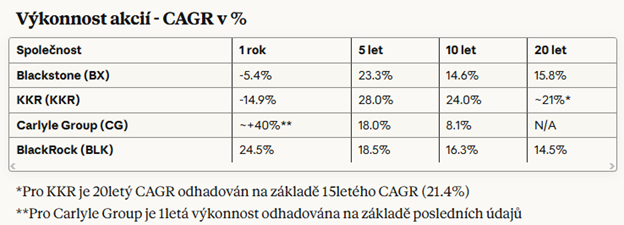
This also brings us to the question of IRR vs. net multiple. Marketing likes to boast about IRR: “Fund X has generated a 20% IRR since inception.” But for an LP, the multiple of capital returned, or net MOIC, is often more important.
The trick is that IRR can be increased by shortening the investment period, which, as we know, a skilled GP can influence to some extent, for example through the subscription credit lines mentioned earlier. In contrast, the multiple on invested capital is much harder to manipulate through timing.
It simply tells you whether $1 became $2, or only $1.60 after a certain number of years.
During periods of strong growth, GPs sometimes communicated performance selectively. For investments that were realized quickly, they emphasized IRR, perhaps 50% p.a. on a successful quick flip, while giving less attention to the fact that the investment represented only a small part of the fund and that the rest of the portfolio, held for longer, generated a lower multiple.
Today, under pressure from LPs, a shift is becoming visible. In surveys, more than 50% of GPs say that in secondary and continuation transactions they focus primarily on MOIC rather than IRR, while fewer than 10% still prefer IRR as their main metric.
LPs also generally report that they assess performance by considering both metrics. This is a positive trend toward greater honesty about actual results.
In conclusion to this series, private equity is no longer a young industry operating in an impenetrable fog of information. It is a mature market with a wealth of data and experience, and it simply has to justify the value it adds.
There are still top-tier funds that consistently generate significant alpha over public markets, and LPs are willing to pay for that. The question is whether the same is true of your private equity investments.
It has also become clear that average performance is far less dazzling than distributor marketing would have investors believe, and that not everything that glitters with a 30% IRR is gold.
The lesson, once again, is the importance of transparency and objective comparison. Rather than simply accepting a GP’s calculations, investors should compare returns with an appropriate public-market benchmark, consider the risk and liquidity involved, and look at performance after all costs have been deducted.
Only then can an investor distinguish between a PE fund that genuinely adds value and one that merely benefits from the illusion that “private is automatically better.”
I originally thought I would end the series here. But the more I thought about the topic, the more it seemed worth adding one final piece in which we at Family Office Partners summarize some of the basic principles we follow when investing in private markets as an LP.
Perhaps they will help others find their way through this increasingly complex part of the investment world as well.
6. A short brainstorming session after the private equity series
For 40 years, private equity was primarily the domain of large institutional investors with dedicated teams of analysts.
Forty years of falling interest rates created an exceptionally favorable environment for debt financing and leverage.
The expansion of EV/EBITDA multiples logically went hand in hand with this.
Operational excellence and genuine business improvement? Only marginally, and successfully in relatively few cases.
2021 to 2025
The number of IPOs declined. M&A activity remained minimal.
Large LPs became locked into massive private equity portfolios, with little or no distributions for several years. Some began facing cash flow pressures as a result.
That is one reason why some follow-on funds are now struggling to raise capital. Actual returns are not meeting expectations.
Some institutions are reducing their private equity allocations, while others have simply stopped increasing them. And the largest investors may not even consider many funds, partly because at that scale, ticket size becomes an issue in itself.
2025
If you feel like the term private markets, whether equity, credit, or infrastructure, is suddenly everywhere, you are not wrong.
Funds of funds and feeder funds are being launched at a remarkable pace, including here in the Czech Republic. Platforms are emerging that aggregate capital and channel it into these asset classes.
I have noticed that whenever “Wall Street” goes looking for the next gold mine, the same characteristics tend to appear:
- limited transparency and complex, layered structures,
- a proliferation of obscure acronyms and calculations that even industry professionals sometimes struggle to understand,
- a sense of exclusivity and a “holy grail” narrative,
- high, often poorly understood fees.
Imagine paying for a bus ticket from Prague to Brno based on whether the driver went faster for a few minutes than during the rest of the journey, only to arrive at the same time as everyone else. Except that, in many cases, the bus stops 10 kilometres short of Brno.
And then comes the machinery of retail distribution, something we know particularly well in the Czech Republic.
Just because an asset is valued only once a quarter, or even once a year, does not mean there is no volatility or risk underneath. Nor does it mean that the NAV shown in your report is necessarily the price you could actually achieve if you wanted to sell.
The secondaries market illustrates the point rather well. An asset can be purchased at a discount to reported NAV and subsequently marked closer to NAV, creating an immediate uplift on paper. It is therefore important to understand not only the reported valuation, but also how that valuation was established and whether it could actually be realized in the market.
Private equity is a great asset class. No doubt about that. Especially for GPs.
But the fact remains that it may not work equally well for every LP.
- Will investors actually be able to select individual funds?
- Are these really the biggest names, or would smaller specialist managers offer greater potential?
- Will feeder funds and funds of funds provide genuine diversification?
- After all the fees, will there still be enough room for excess returns?
- Where will the largest PE firms find enough high-quality companies to deploy their growing amounts of capital? And at what valuations?
- And when will they be able to execute exits, when even smaller managers are struggling to do so today?
I believe people have the right to decide what they want to invest in. It is a good thing that investors today can build portfolios across assets with different durations, volatility, cash flow characteristics, expected returns, and risks.
What I find harder to believe is that, instead of getting a “Jack Bogle of private equity” who would turn access to the asset class into an extremely efficient, low-cost product priced at a few basis points, we are getting products with all-in costs of 3–7% p.a.
The index revolution that Jack Bogle helped start drove investment costs toward just a few basis points. Private equity, meanwhile, can come with all-in costs of several percentage points a year.
As with any other asset class, finding genuinely attractive opportunities requires time, experience, and resources.
Unless, of course, you are willing to pay a premium for beta. And perhaps not even beta anymore, but a lower return in an environment where a forty-year cycle has ended and the market is searching for a new equilibrium.
That is something every investor has to decide for themselves.
Disclaimer: Family Office Partners naturally invests in private equity as well. But it is challenging. We see firsthand how difficult it is to identify funds that have a realistic chance of maintaining their performance in today’s more demanding environment, where returns meet expectations and remain relatively consistent over time rather than depending primarily on cycles of cheap money.
7. Article sources:
History and development of private equity
- Harvard Blog Archive | Private Equity: History and Further Development
- NYU Journal of Law & Business | Evolution of Leveraged Buyouts: A New Era or Back to Square One?
- Wikipedia | History of Private Equity and Venture Capital
- Wikipedia | Private Equity in the 2000s
- Overlord Fund | The History of PE: The 2010s (2010–2015)
- University of Oxford (Research Paper) | The Eclipse of Private Equity
Key Figures and Famous Transactions
- Wikipedia | Michael Milken
- Investopedia | Corporate Kleptocracy at RJR Nabisco
- PitchBook | This Day in Buyout History: Biggest LBO Ever
- Medium (Felix Salmon) | The Hilton Trade (Blackstone Case Study)
- Carlyle (Press Release) | Carlyle Raises $1.8bn Second Asia Buyout Fund
How PE funds work, fees, carry, NAV
- Net Interest (Marc Rubinstein) | Cash is King
- Fordham Journal of Corporate & Financial Law | GP Compensation Terms in the 1980s
- ECGI Working Paper | Private Equity and Net Asset Value Debt
- Private Equity International | Hamilton Lane Semi-Liquid Carry Structure
- Hamilton Lane | The Truth About Secondaries
- Sadis & Goldberg LLP | The Growth of Secondaries in Private Equity
Criticism, risks, and illusions of private equity
- Institutional Investor | How Ludovic Phalippou Became the Bête Noire of Private Equity
- Institutional Investor | Why Does Private Equity Get to Play Make-Believe With Prices?
- American Affairs Journal | Private Equity: Overvalued and Overrated?
- Financial Times | Is Private Equity Becoming a Money Trap?
- Morningstar | The Illusion of Liquidity
- Alpha Architect | Structured Notes: Wall Street Fairy Tales to Avoid
- AQR (Cliff Asness) | Volatility Laundering
The Market After 2020: Boom, Rates, and Exiting the Crisis
- McKinsey (PDF) | Global Private Markets Review 2024
- Bain & Company | Private Equity Outlook 2025
- S&P Global | Private Equity Exits Plummet in 2022
- Wellington Management | Impact of Higher Interest Rates on Private Equity
- Fuld & Co | How Private Equity Is Faring During Tumultuous Times
- Grata | The Denominator Effect Explained
Institutions, LPs, and Long-term Trends
- NBER Digest | Limited Partner Performance and the Maturing of PE Industry
- CalPERS (PDF) | CalPERS Investment Report (2020)
- IMF (PDF) | The Rise of Sovereign Wealth Funds
- Timeline | Jack Bogle: The Man Who Revolutionised Investing
The Retailization of Private Equity and the 401(k) Debate
- Montaka | Blackstone & KKR Want to Put Private Equity in Your 401(k)
- Reuters | Trump’s 401(k) Order Offers Crypto and Private Assets
- Forbes | Inside Private Equity’s $29 Trillion Retirement Savings Grab
- Private Equity International | Trump’s Executive Order as a Chance for PE
- Schroders | Attractions of the Small-Mid Private Equity Segment
- Harvard Blog Archive | Private Equity: History and Further Development
- NYU Journal of Law & Business | Evolution of Leveraged Buyouts: A New Era or Back to Square One?
- Wikipedia | History of Private Equity and Venture Capital
- Wikipedia | Private Equity in the 2000s
- Overlord Fund | The History of PE: The 2010s (2010–2015)
- University of Oxford (Research Paper) | The Eclipse of Private Equity